Reportback on the meeting of the Puget Sound Manufacturing and Industrial Council on Wednesday, May 6, 2026
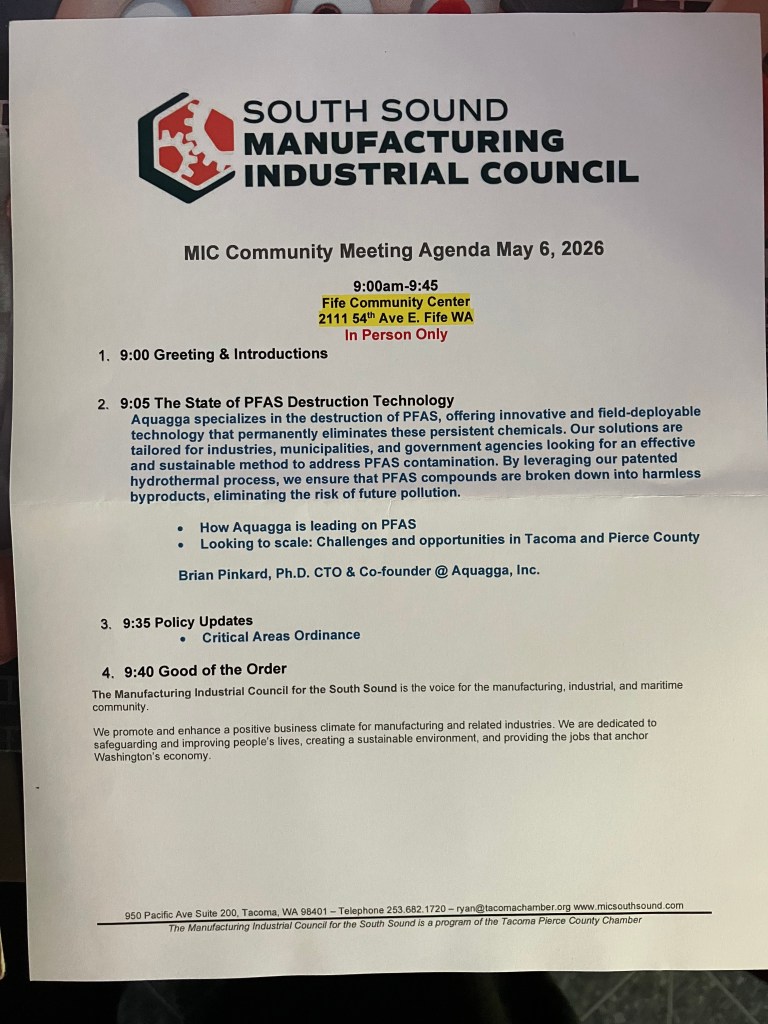
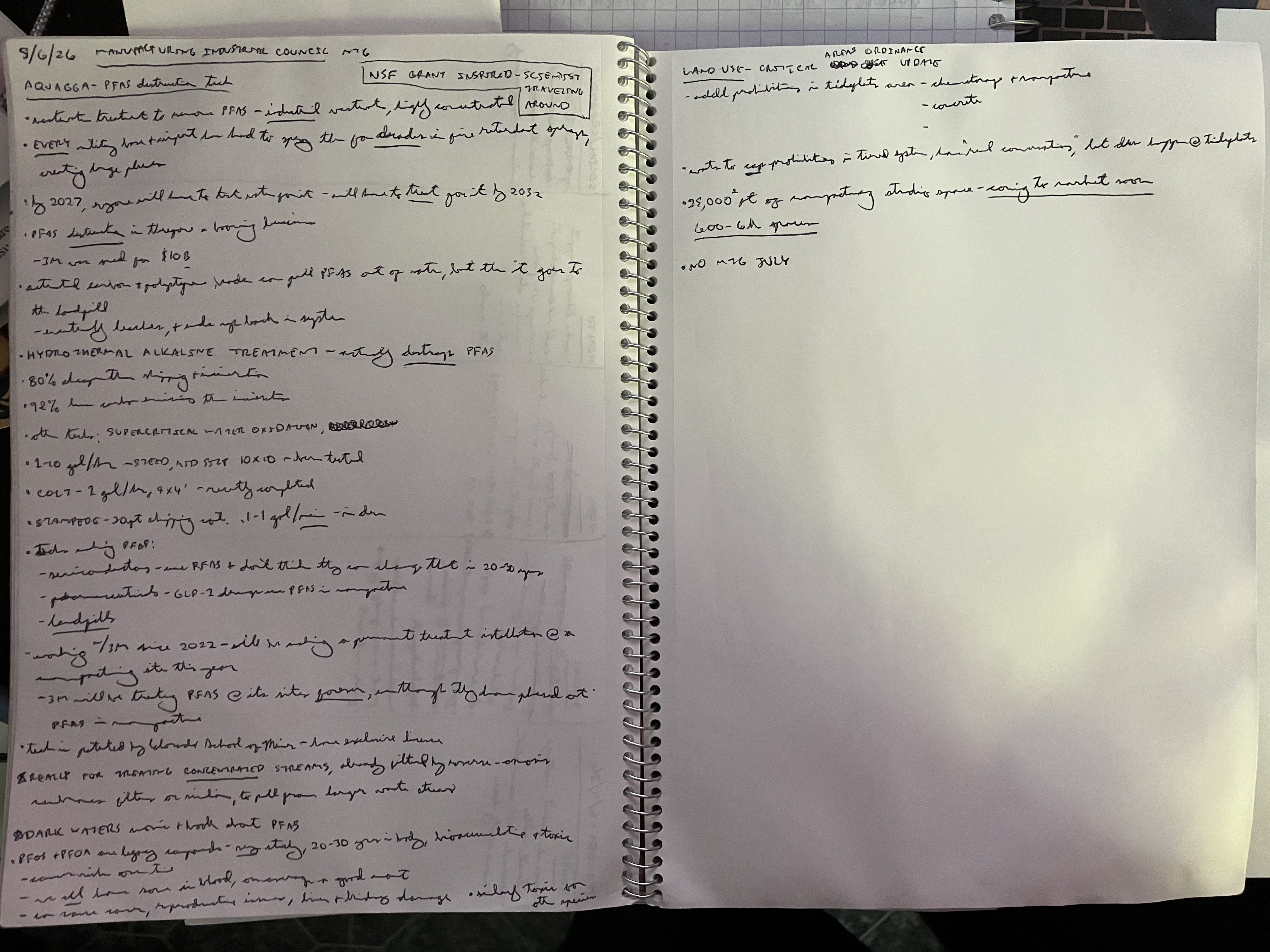
The bulk of the meeting was a presentation from a local (Tacoma) business Aquagga that is developing on-site installations to destroy PFAS from concentrated waste streams. Their technology, Hydrothermal Alkaline Treatment, was developed at the Colorado School of Mines (a professor from the college is one of the cofounders of the business), and they have an exclusive license to commercialize it.
Their current units come in three different sizes, with variable processing speeds. The smallest, the “Colt”, has only recently been constructed and has not yet gone through an on-site tesating period. It can process 1 gallon an hour, and has a 4×4′ footprint.
Their mid-size unit, the “Steed”, has been tested and gone through multiple iterations, and can process 1-10 gallons/hr, with a 10×10′ footprint.
Their largest unit, the “Stampede,” is currently in development, fits in a standard 30′ shipping container, and can process .1-1 gallons/minute.
Because of the limited volume that can be processed at a time, this is not a technology they are developing for broad water sources like the Puget Sound or municipal sewer systems. They are targeting more targeted waste streams which are especially likely to be contaminated by PFAS, such as landfill leachate, pre-filtered streams in wastewater treatment plants, and former and current industrial sites. They currently are contracted with 3M to create an installation in one of their manufacturing facilities. 3M recently settled multiple lawsuits for 10 billion dollars related to PFAS pollution as a direct result of their historic use of the chemicals in their products over past decades. Despite having phased out their use, they will be cleaning up these chemicals probably as long as the company is in existence.
Other major targets for the use of this technology are the pharmaceutical industry, and builders of semiconductors. PFAS are currently used in the production of GLP-1 drugs like ozempic etc which are experiencing a major wave in popularity both by prescription and under the counter. They are also used in semiconductor production, which is a necessary part of the production of the processors powering the massive server farms being built worldwide to support growing needs for cloud computing and AI-driven technologies. This industry has no plans to phase out the use of PFAS over the next 20-30 years, and use vast amounts of water in their industrial processes, all of which could be filtered and processed using this technology.
The benefit of the Aquagga technology over existing methods of removing PFAS from the environment is that Hydrothermal Alkaline Treatment provides complete destruction of these chemicals. Existing methods may filter these chemicals from wastewater, but they must then be shipped either to a landfill or to an incinerator, and then to a landfill, all of which is costly and concentrates the chemicals, but does not destroy them, which means they then inevitably leach from landfills and into groundwater where they recirculate through our ecosystem. Since industrial producers are already concentrating these waste streams to reduce shipping costs, Aquagga’s installations are a very appropriate technology to fully purify this wastewater, while avoiding the costs of shipping, incineration, and fees related to waste disposal.
So, that was cool to learn about, especially seeing this kind of innovative work in the Tacoma tideflats area.
The rest of the meeting was short notes from Ryan Spence, including:
- MIC is advocating against restrictions of industrial uses of commercial property in the tideflats. They don’ believe it is as environmentally harmful as for example having those industries in the puyallup river watershed. Idk about that.
- Ryan announced they will be soon opening applications to the first cohort of their manufacturing business incubator, due to launch in September. No further information at this time.
- There will be no MIC meeting in July
- Announcing a new incubator space opening by the MIC, to provide 600–6,000 sq ft manufacturing studio spaces for startups and small businesses in a 25k sq ft facility, coming to market soon. No further information on pricing etc.
I spoke briefly with Ryan after about my new partnership with C4 labs, and he sent me some resources looking for small business loans and support. He continues to be impossible to pin down for the promised coffee meeting (I have been trying for over a year).
 Gene Kemper