Overall Impression
It was a good small group, about 12 people came, so we were able to have some really good conversations about the specifics of our businesses. It was a very broad spectrum, from a potter to someone who runs a comedy club and someone organizing nonprofit community arts events. I will be presenting a workshop at the June session, so we also took some pictures with the instructors for that session, who were all present–me, Gwen Kohl (below), and Jacque Rardin from Mighty House Media. I was also able to take a group vote from the other participants on what they wanted from my June workshop, and they voted between two options. They chose a prototyping workshop, where I will be teaching about the Design Cycle and how it can be applied to any product or service, to reframe failure as a part of development to be accepted and embraced.
Session 1: Andy from Own Your Awkward
This session was focused on assessing the relationships in your life as a business owner in order to map out what roles people are currently holding in your life, and what roles need to be filled, so you can more effectively rely on the support system you already have as well as see more clearly where you may need to grow.
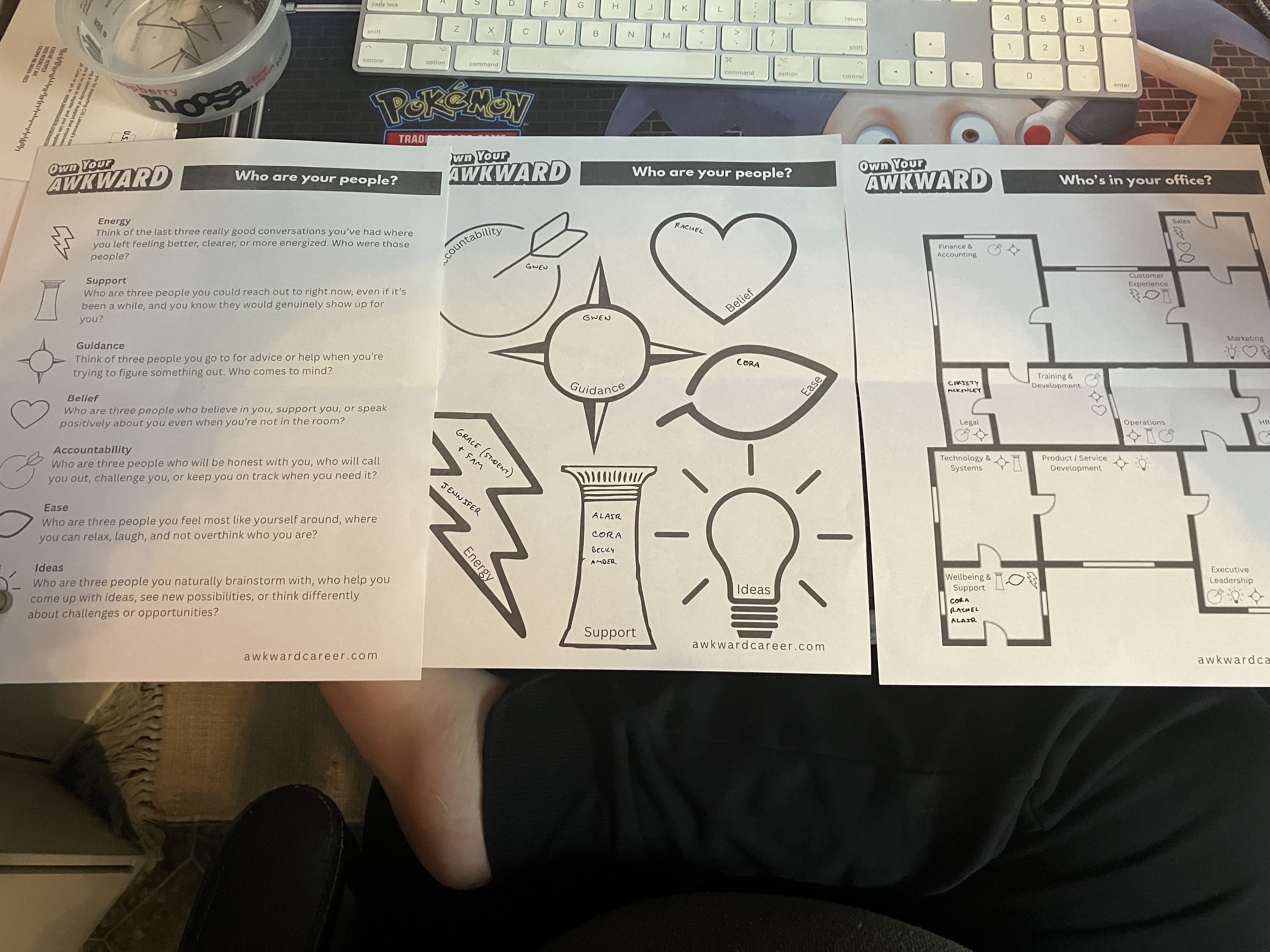
Some good takeaways:
- We often tell kids to do things we never are willing to do as adults–for example, telling a kid at a playground to go and ask other kids to be their friend. We never do that as adults.
- Insight from another participant: many adult friendships come from the workplace–but entrepreneurs are often working solo, so we have to be extra intentional about creating places in our lives to meet and interact socially with others (these workshops are a good example of that)
- Insight from another participant: a good rule of thumb when looking for a new job is that you need at least 8 people in your life to know you’re looking for a job, and what kind, for your search to be successful. The same rule applies to entrepreneurs–if no one knows what we’re trying to do, we’re not letting them support us.
- Extended conversation on social media, and successful marketing vs spamming our network, and how that can be a fine line. Andy pointed out that statistically, even of the people who follow you online, only 10% will see what you post, so making one post about (for example) a new book release is NOT “getting the word out” about it.
- Further conversation about determining what your ask/tone is in social media posts–for example, if you are constantly posting about needing help, people in your network will start to wonder if this is a reasonable/potentially successful business venture at all. My example given was that no one wants to throw money at a sinking ship– if a local business posts about needing 40k for back taxes within the next month, for example, they are unlikely to get the support they need–not because people don’t care about their business, but because people also care about how they use their own finite resources and throwing $20 at someone who now has no realistic way to meet the goal they claim is the only way to stay in business will feel like drops in the bucket and the bucket already has a hole in it so what’s the point. It is more effective to be transparent earlier on in your struggles and be proactive and upbeat–in the example linked above they could have been holding ‘tax sale sundays’ for example to drive business and build the revenue to pay their bills.
- Andy advises selling to the customer’s need, not just the product you sell. His example is that he is an event speaker, which means people will only look to book him when they have an event come up–once or twice a year at most. However he provides team building, communication improvements, collaboration skills–and businesses need these things *all the time*, so framing what he sells that way helps incentivizes potential clients to plan events with him.
Session 2: Business Financials Essentials with Gwen from Business Impact NW and Firefly Financials
Gwen introduced some basic business financial terminology, and we had an extended group conversation clarifying what the terms mean in different contexts. Some key points were:
- Clarifying the differences between a Business Model and an Economic Model. A business model is how your business operates–an economic model is how your business benefits you. This can go beyond profit; for example, you may profit little on paper, but successfully barter using your business to meet other of your needs.
- COGS (costs of goods sold) is not your price, but what it costs you to do something. It may not include your labor as a business owner. You are compensated through an owner’s draw from the profits of the business, not through wages, so you are essentially “free labor” for this calculation unless/until you are paying someone else to produce something for your business.
- Cashflow–are you making money or just moving it around?
- can come from your business operations (sales), but also investments (from you or others), or from loans.
- Pricing–ensure you are pricing with margins that will cover your direct costs in producing the products or services
- direct costs may depend not only on the COGS but on how you are selling–ex online selling will include fees for online sales platforms, credit card payment processing, shipping, etc. but in-person selling may include a sales commission from retailer, wholesale discount, booth fees, transportation, retail packaging, etc.
- Costs of booth fees etc for IRL sales can be considered in COGS OR as an overhead expense, depending.
- Breakeven–how many units do you have to sell before you start to make money? You can calculate this many ways, including:
- by product: some products are more profitable than others and therefore will reach breakeven with fewer units sold
- by market: expenses may vary between different sales points because of the expenses involved, so a local market with a low booth fee may reach breakeven with only a few sales but one with a high fee that requires travel and lodging will require more sales
- by timeline: some products require a large upfront expense (like printing 500 t shirts) but sell at a steady predictable rate (like those t-shirts being bought by kids sport teams when the season comes around), so you can calculate breakeven by how many months from production to minimum sales reached. You also may group all your products and various avenues together and look at breakeven by your monthly sales in general–at what point in each month are you breaking even? If you’re breaking even on the 30th of every month, what can you do to break even earlier so there is more time to be actually making money?
- If a client cannot meet the rate of your services, you may consider discounting for the relationship value, but should still:
- invoice them your full rate, but visibly include a discount if you agree to it, so they know what you’re worth and can factor that into future budgeting
- barter for other ways they can help your business with in-kind services or other benefits, such as:
- referring you to other clients
- writing a testimonial for your website
- providing you with photos or videos they take of the event (or whatever) for your own marketing and social media
- review your business on google
- share your business on social media
- discounts on their products or services for your business
- Recommends researching post-capitalist business resources–there are many ways to focus on commerce without the obsess
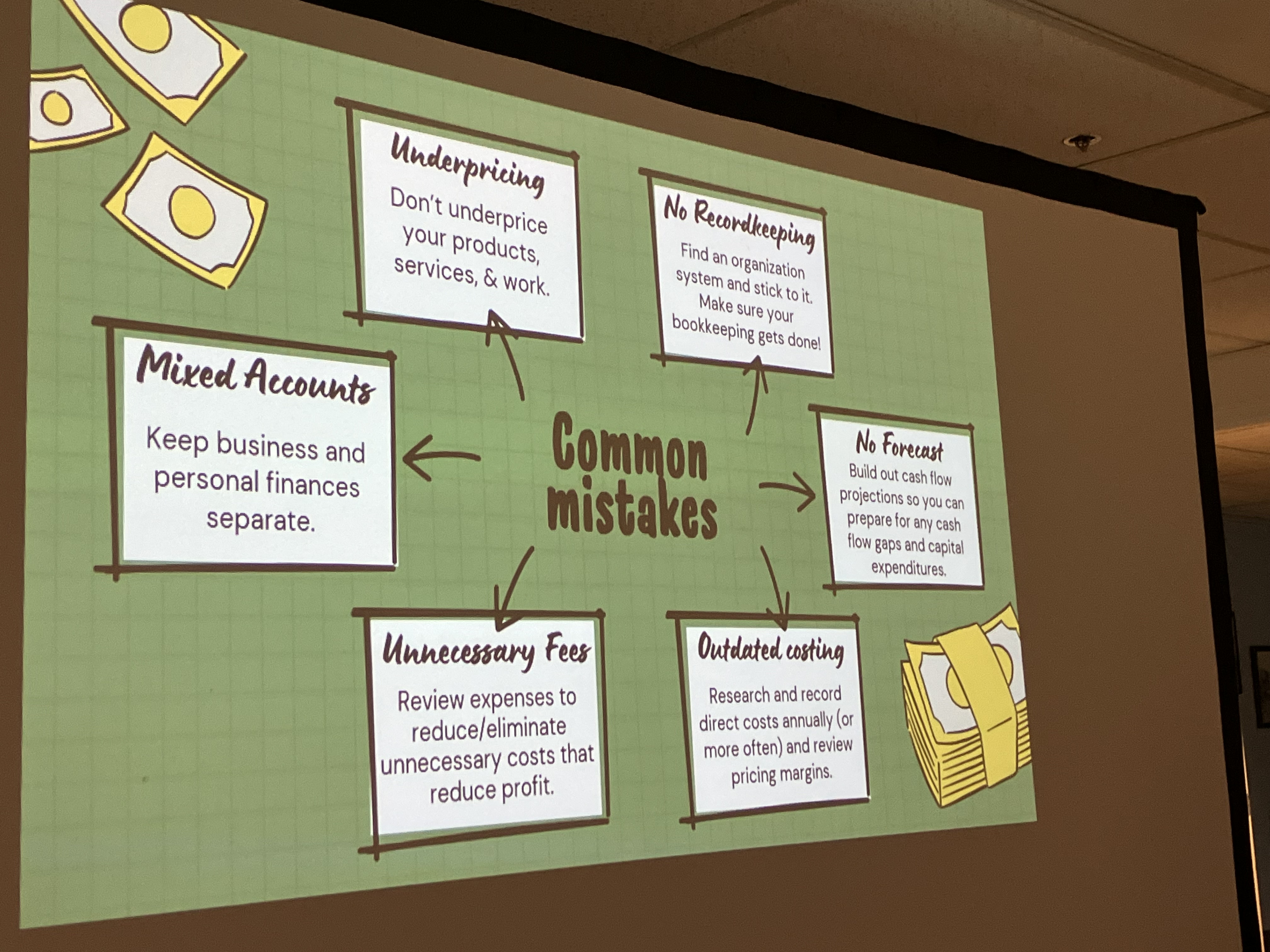
Action Items:
- I signed up for free business coaching with Gwen, because I need some additional support and structure to keep on track
- I also signed up for a workshop on 4/21 called “square one”, I’ll see what that’s about but not sure it’s what I need (no description was provided, but it was a part of the coaching registration process)
- I really, really need to catch up on my business paperwork and get my financials right
Session 3: Creativity Flow with Katrina Van Strien from Pearl Art Therapy
In this session the goal was an art therapy practice designed to bring left and right brain thinking together ina creative flow exercise that is not at all based on the end product–the process is the point. We each got paper and a different color of pastel for each hand, and were told to draw the same thing at the same time with both hands. We then went around the room, taking turns to call out a prompt, while continuously drawing and remembering to breathe in and out to a count of three, which was surprisingly difficult to do all at the same time. Some prompts included drawing circles, spirals, tiny circles, triangles, crowns, hearts, cat faces, to color in line intersections, to color in the borders, and to zig-zag across the whole page. next, we turned our pages over and wrote the prompt “what am i noticing?” with our dominant hand, while having to respond with our non-dominant hand.
What I noticed was the level of fatigue and pain I experienced from my non-dominant (left) hand, and how much more quickly it lost control as a result. I also noticed that focusing on what it was doing, and not my right, didn’t improve it–but did make my right hand worse. Other participants observed that at some times it felt more natural for one hand to follow the other, while at others it felt easier for them to mirror each other’s movements, and also that it felt very difficult to keep breathing deeply. We took a little gallery walk of each others’ finished drawings, which varied hugely in approach. One person told me mine looked like a neurological brain map. It was interesting to see how different people interpreted the instructions and prompts. Finally we asked if there was a way we could apply our observations to thinking about our business, and Andy reflected that based on my ‘share,’ you may have areas in your business where you are less skilled or less strong, but sometimes focusing on improving those will not actually be as successful as keeping the focus on your strengths. Another participant shared her fear of losing control of her dominant hand, and another shared that she also had that fear and regularly practices writing with her non-dominant hand as a result. In private reflection, i wondered if pain is a sign of weakness in the literal sense, and therefore is that weakness something to be accounted for as normal, or something to be eliminated through intentional practice? In a different framing, is weakness and suffering in performance just a sign of being asked to do something I’m maladapted to, and if it is the task/ask that is the problem? Because I don’t consider my left hand to be weak–it just does different things than my right hand does, and I use them both together.
 Gene Kemper