I have come to an agreement with Dustin from C4 labs to onramp into taking over the manufacturing of his products while he goes into a focus on design work through a sort of internship, where I will be spending all my free time possible working with him and learning his processes while I am also recruiting subletters to share the space under the new lease, clients to pay me for production work, and launching my own products for sale online.
My goal is to be able to run this business backend by July, so Dustin can take a month off completely. At that point I need to be ready to make my nut, which is roughly $3200 in overhead expenses a month, before paying myself.
5/14
Spent 4 hours this morning with Dustin getting the DL on the UV printer and router. We discussed the ins and outs of his prototyping process, and decided as an internship process for me, to go through the prototyping process for a new product he’s been meaning to get to, a Settlers of Catan board.
5/18
Spent all day on Friday at C4, 7 am-4:30 pm.
- Arrived at 7 am to beat the upstairs neighbors with making laser fumes. Set up a demo file to cut on one of the lasers and learn the workflow there. I made in scrap mdf a version of a file I’ve cut before in 3 mil ply, a saw handle, and also a Settlers of Catan tile. Cut them out using Lightburn on the mama bear laser.
- Learned more about how C4 uses shipstation to track orders and print shipping labels, and learned more about the packaging/shipping process, and how that interfaces with his visual inventorying system
- Learned about calculating the price of products to produce and how to systemize that using a spreadsheet to track expenses and set retail prices for products
- Spent the rest of the day learning FreeCAD until my brain was melting out of my ears. It seems honestly easier than fusion in some major ways, and because it’s built for 3D making, it is more precise than corel can be, even for designs you only need 2D vector output for. As an opensource product, Dustin also is looking towards the future, of people using AI (or using AI himself) to make highly specialized tools to add on to the software to improve workflows, which is a big advantage over a closed system like fusion\
- Afterwards, stopped by Tinkertopia to pitch Darcy on sign and display making and possible subletting for storage and kit-building space, since we’re just a couple blocks away from the shop. They already have a hand-painted sign maker lined up to remake their blade sign, but they might need the 3D shape re-cut.
On Saturday I met with my former business partner at Yarvi for 2 hours, and he is interested in being a subletter in the space. I’ll be showing him around on Thursday morning. I also presented him with some of the possibilities in continuing to contract with me in producing laser-engraved and UV printed signage, as well as producing flatpack portable furniture for his glamping set-ups using the CNC router. I spent a good part of the afternoon brainstorming products to develop under my own name, which is a high priority so I can make the best use of Dustin’s guidance when it comes to getting products listed online and developing a shipping workflow. I have some solid ideas based on designs I’ve already done some prototyping on.
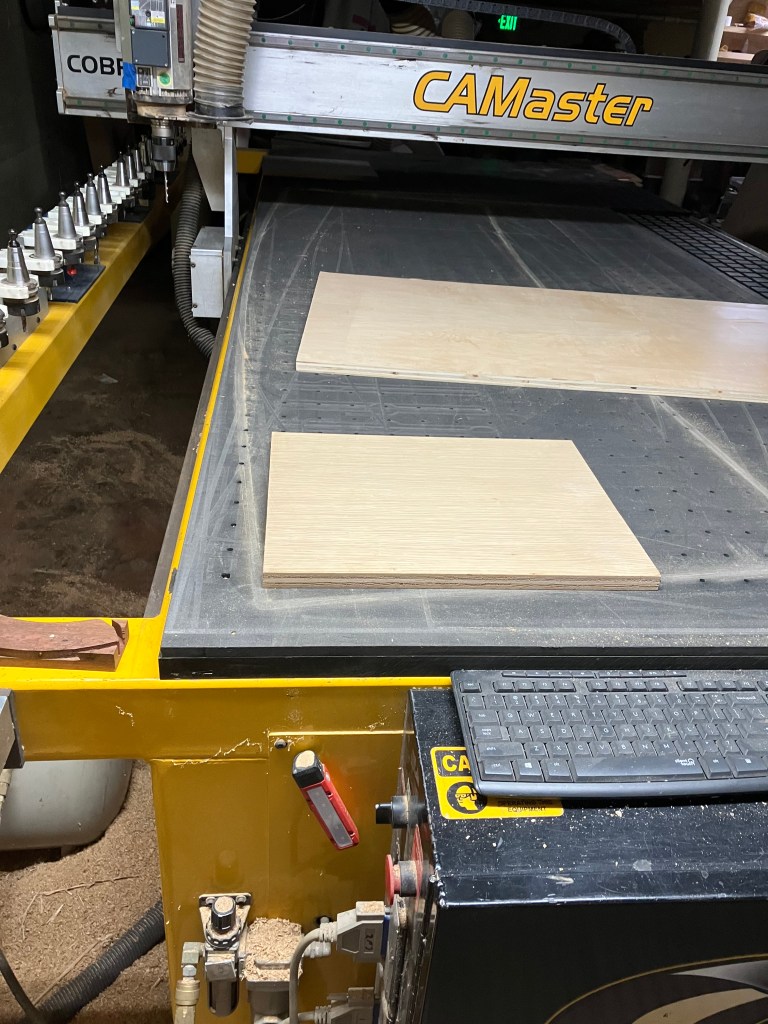
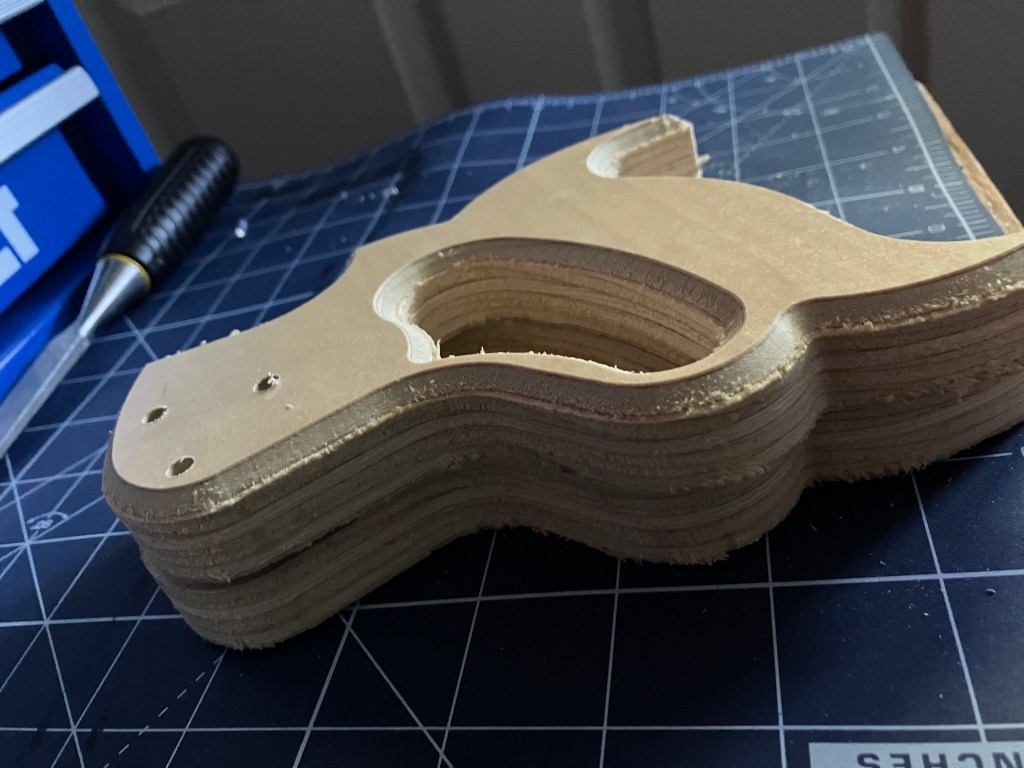
This morning I went back for a few hours (7-11) to try out the router for the first time. I started with my same saw handle project that i have successfully laser cut. Routing would be a big improvement, because instead of stacking and glueing multiple layers, I could just have 2 layers with a routed pocket to insert the blade. It would also likely improve my screwpost hole consistency; when laser cut, I have had to re-drill the holes after glueing to make the bore consistent. I can also use a V carving bit to contour the handle, and cut down on my sanding time.
Spent all morning going between Corel, Aspire, and WinCNC Controller learning how to make toolpaths work the way I want, and successfully did a dry run, but my final cut hit a problem when the vacuum suction of the router table was not strong enough to counter the lateral force of the V carve bit. So I’ll pick that back up, maybe tomorrow morning. Before I left Dustin showed me how to mask the vacuum table to better improve the draw on my material. Hopefully that will be the fix.
6/14 Update
I have been spending basically every hour I can over the past month at C4, learning the workflow and machines from Dustin. I will add the hours to my skill spreadsheet that specifically reflect subtractive skill building, but there is a lot more that doesn’t neatly fall into place.
To summarize:
I have spent about 6 more hours in several sessions on the router, learning how to correct my issues and making fun and exciting new issues for myself.
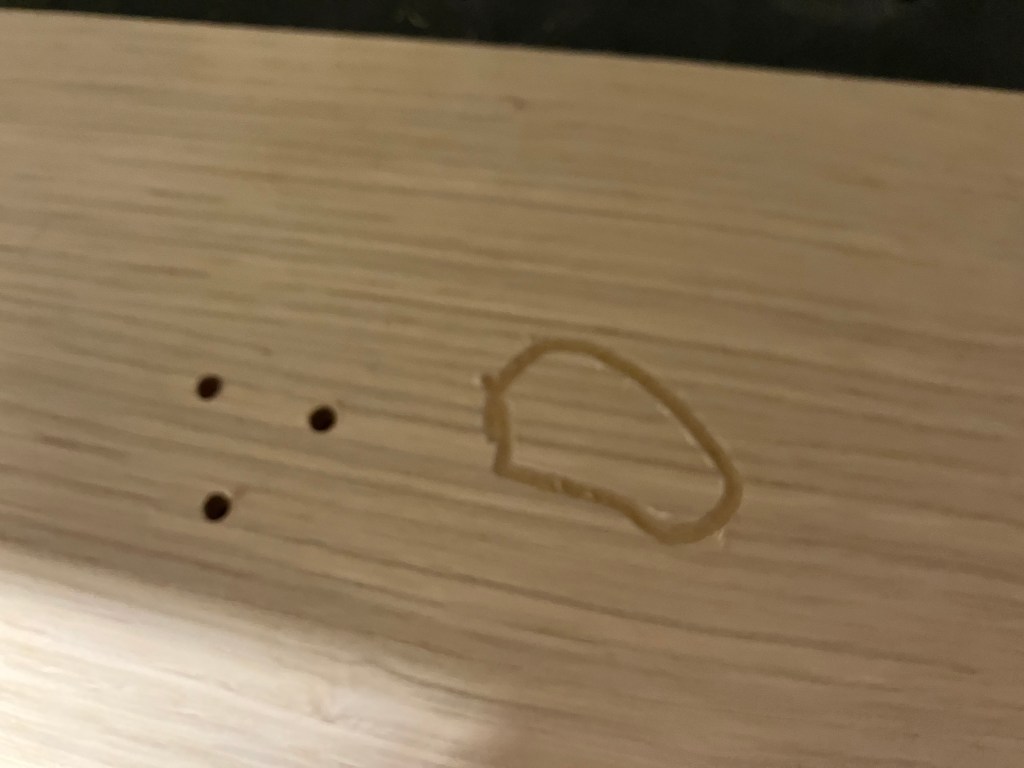
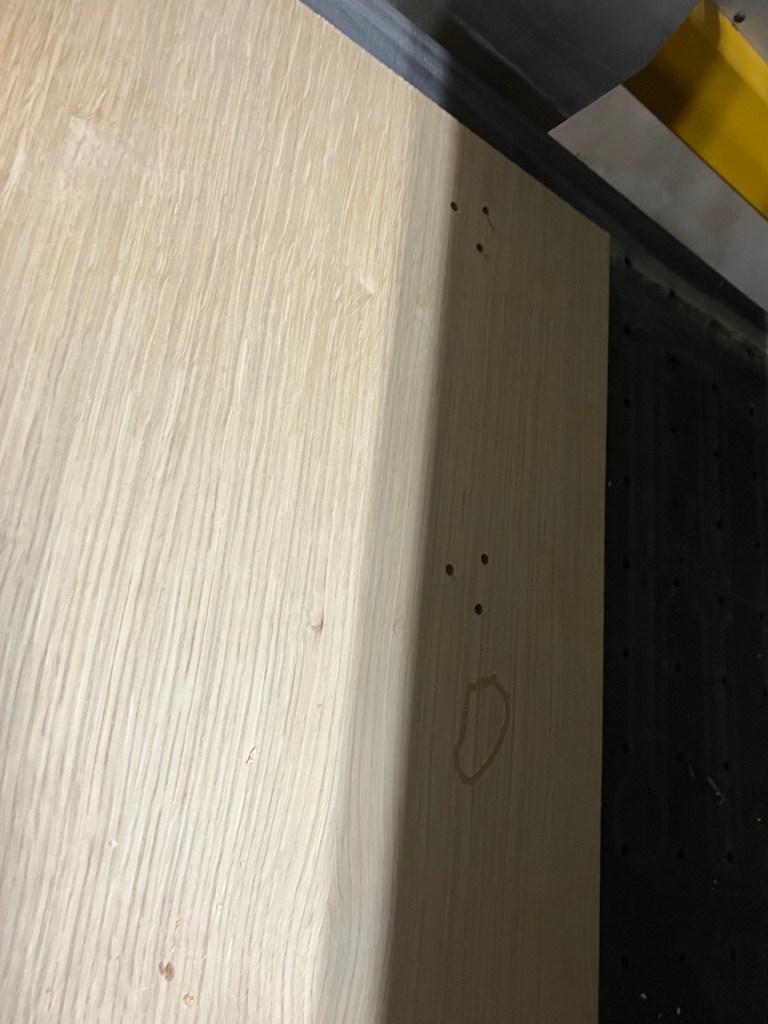
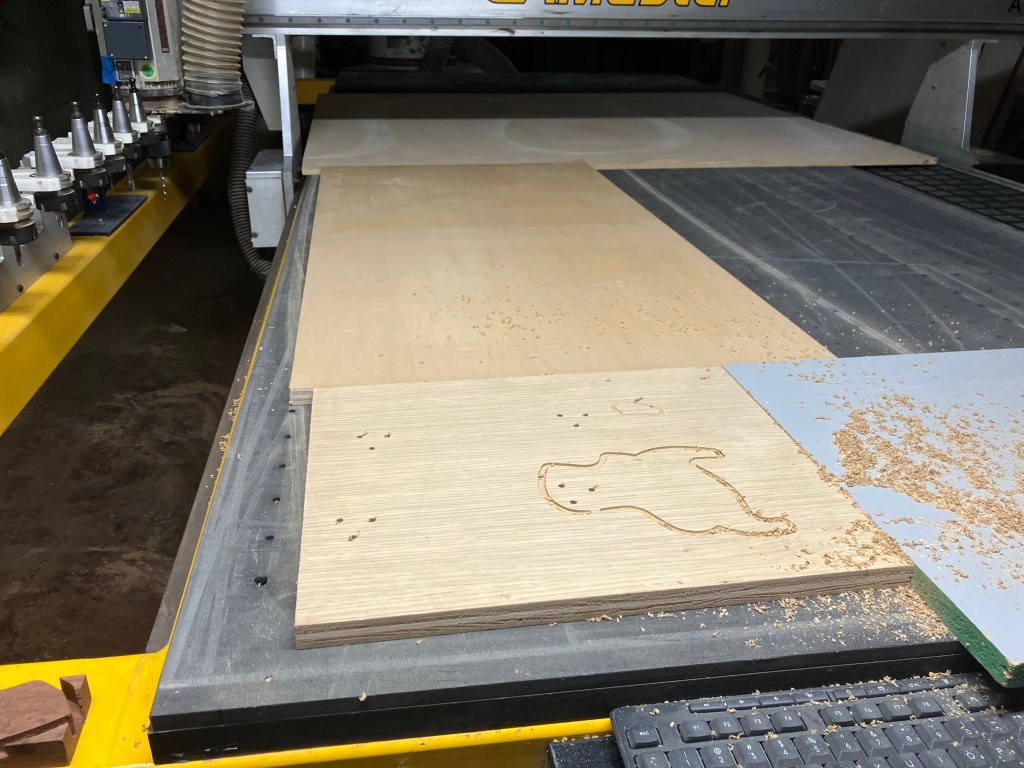
After more successfully masking the vacuum table of the router, I was able to get my pieces cut. I cut each saw handle side out of 1″ plywood, which turned out, unsurprisingly, wayyy too thick for a saw handle. The pocket depth for the saw blade was good, but the need to cut that pocket meant I couldn’t chamfer the edges on that side. I attempted to prototype a jig I could use to route the pocket, then flip the piece and cut the perimeter and chamfer the edges, but didn’t quite dial that in yet. I could only find a 4 mm drill bit, not a 3 mm, but found that was actually a better fit for my 3mm chicago screws.
I have been working on a retail product design; a pin loom. I have previously made laser-cut versions of this for my girlfriend, who is an avid weaver, in various sizes. However the laser has several problems for mass manufacture.
- First, getting all the layers aligned and clamped during gluing is a pain.
- Second, there is substantial charring around the edges that is time consuming to fully remove, but which is necessary in order to actually use them without discoloring the yarn used to weave.
- Third, the nature of a laser cut means the edges are not fully perpendicular, so a design that uses stacks of the same shape to build up the correct thickness of material then needs to be sanded in order to have a consistent edge.
- Fourth, aligning the pins vertically is greatly challenging, and it is time consuming to cut off the heads and level the tips.
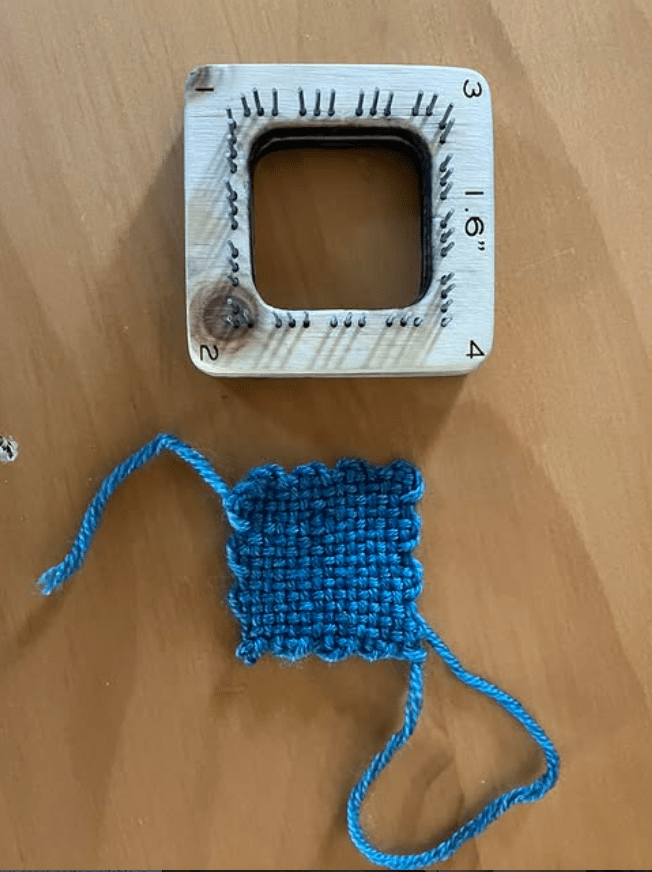
So altogether, a redesign was necessary.
My new plan is optimized to take advantage of the equipment available at C4, by routing the frames rather than laser cutting them. I can also use a drill bit in the router to pre-drill the holes for the pins, which will keep them precisely aligned without dealing with any charring. The router will allow me to chamfer the edges, further cutting down on time spent on finish work. I can then use either the laser or the UV printer to engrave or print guiding marks, decorations, and other information/branding directly onto the wood.
The pins are another obstacle, but I think I have figured out that what I need are 1-1.2 mm watch band spring pins, rather than wire or true pins. They are less expensive than dowel pins, and come in the right tiny diameters and length of 1-1.5″. Like dowel pins, they have a bright finish and have been cut to length, not sheared, so they don’t have any sharp burs. Best of all, they have a cut knurling at one end that will keep them embedded in the wood and not swiveling in the hole, once installed.
I have redesigned a basic pin loom frame in freecad, but plan to iterate on this design further, maybe cutting the frame in two parts instead of as a single square, to better maximize my material usage through improved part nesting.
Some other skills I have been building are:
Workign with C4’s lasers. They are all no-brand Chinese models that Dustin knows inside and out, but that knowledge is hard to find elsewhere all in one place. I am learning how to run and maintain them bit by bit, and mistake by mistake.
Similarly, I have gotten to the point of independently running jobs on the UV printer, including setting up jigs, doing basic machine maintenance, running test prints, adjusting jig setups, setting up jobs in the software, and running batches. I have also learned how to edit bitmap files for accurate color printing, although I havent gotten to test this skill yet.
learning the shipping and customer service workflows. C4 sells through numerous online marketplaces, which are all managed through Ship Station and email as well as individual seller accounts. I have begun handling customer issues through these platforms and preparing orders for shipment.
I have been learning the workflows for assembling various product kits for shipment.
I have been learning more about the supply chains for the business, including ordering supplies, storing them, quality checks, and price comparisons between vendors.
I have been learning about pricing for various products.
 Gene Kemper